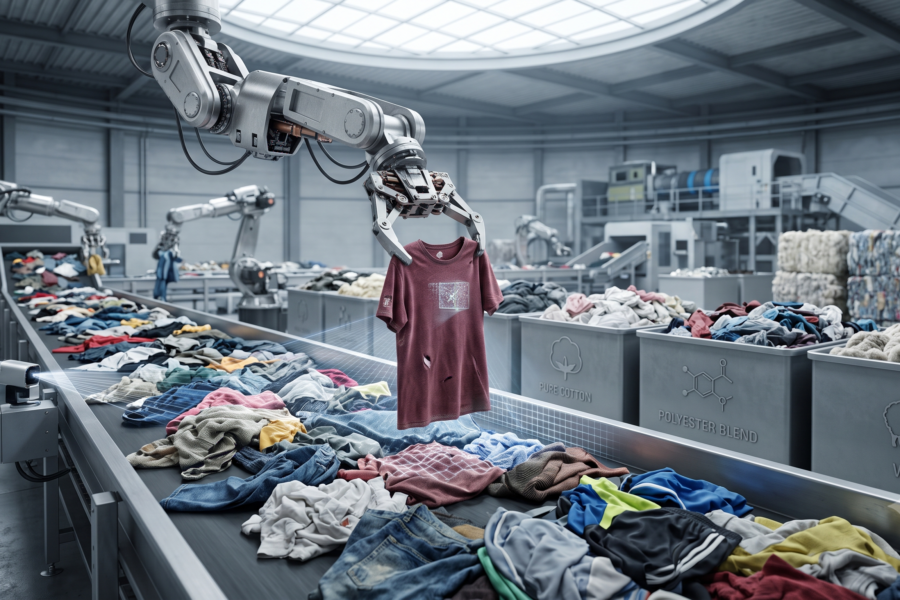
The Rise of AI-Native FashionBrands Built Entirely Around Data
AI for Fashion — Emerging & Frontier
The Rise of AI-Native Fashion Brands Built Entirely Around Data
Every brand examined elsewhere in this series adopted AI. A small but growing number of fashion companies were never anything else — built from the first product decision around a data pipeline that legacy retailers spend years and tens of millions of dollars trying to retrofit.
June 2025
13 min read
The distinction matters more than it sounds. A legacy retailer bolting AI onto decades of organisational habit, legacy systems, and human-judgement-shaped workflows faces a fundamentally different transformation problem than a company that designed its org chart, its supply chain, and its product cycle around a data pipeline from day one.
Nearly every brand discussed elsewhere in this series shares a common starting condition: an organisation built around traditional fashion processes — seasonal buying calendars, human merchandising judgement, manually managed supplier relationships — that has subsequently adopted AI tools to improve specific functions within that existing structure. Zara’s RFID-driven replenishment, H&M’s markdown optimisation, PVH’s digital sampling: these are all, fundamentally, AI capability layered onto an organisational structure that predates AI and was not originally designed around it.
A distinct and smaller category of fashion companies has taken the opposite path: building the entire organisation, from the first product decision, around a data pipeline and an AI-informed decision-making process, rather than retrofitting one onto an existing structure. These AI-native brands typically look different from traditional fashion companies in ways that go well beyond which software tools they use — different organisational structure, different talent profile, different speed of iteration, and in several cases, a fundamentally different relationship between the brand and the customer data that drives its decisions.
This article examines what genuinely distinguishes an AI-native fashion brand from a traditional brand using AI tools, profiles several companies that illustrate the model, and asks the harder strategic question this category raises for the rest of the industry: is AI-native structure a genuinely durable advantage, or a temporary head start that legacy brands with greater resources will eventually close?
What “AI-Native” Actually Means
The term “AI-native” is used loosely across the industry, often to describe any brand that has adopted AI tools enthusiastically. The more precise and useful definition is structural rather than tool-based: an AI-native brand is one whose core operating cycle — what gets made, in what quantity, marketed to whom, priced at what level — is determined primarily by a continuous data feedback loop rather than by a seasonal human planning process that AI tools subsequently assist.
This distinction shows up most clearly in production cycle time. A traditional brand, even one using sophisticated AI demand forecasting as covered earlier in this series, typically still operates on a seasonal buying calendar — collections planned months in advance, with AI improving the accuracy of those seasonal bets rather than replacing the seasonal structure itself. An AI-native brand frequently has no meaningful seasonal structure at all: production decisions are triggered continuously by real-time signal, with the gap between a trend appearing in the data and a product reaching customers compressed to days or weeks rather than months.
The organisational consequence is significant: AI-native brands typically employ far fewer traditional “merchandiser” or “buyer” roles relative to revenue than legacy retailers, with much of that judgement function either automated or restructured into a smaller team interpreting AI output rather than generating buying decisions independently. This is not necessarily fewer total jobs — many AI-native brands have correspondingly larger data science, growth marketing, and supply chain operations teams — but a genuinely different distribution of where human judgement is applied within the business.
Two Different Operating Cycles
AI-Adopting Legacy Brand
- Seasonal buying calendar, AI-improved
- Human merchandiser as primary decision-maker
- AI assists existing planning process
- Months between trend signal and product
- Org chart predates AI adoption
AI-Native Brand
- Continuous data-triggered production
- Data pipeline as primary decision driver
- Human judgement interprets AI output
- Days to weeks between signal and product
- Org chart designed around AI from inception
Cider: Social Signal as Production Trigger
Cider, launched in 2020 and built explicitly as a social-first, data-and-community-driven fashion brand from inception, illustrates the AI-native model clearly. Rather than a traditional buying team predicting seasonal trends, Cider’s product decisions are driven substantially by real-time social media engagement data — tracking what styles are generating engagement on TikTok and Instagram, including engagement with Cider’s own community-generated content, and using that signal to trigger production decisions on a much faster cycle than a traditional seasonal calendar allows.
Cider has built this data-driven approach progressively deeper into its organisation. The company has expanded its use of retail intelligence platforms to unify design, planning, and marketing decisions around shared, AI-processed market data — moving, in the company’s own description, from simply tracking trends to embedding data-driven decision-making across every stage of the product and campaign lifecycle. This reflects a structural pattern common across AI-native brands: the data layer is not a single tool bolted onto one department, but connective infrastructure that multiple functions reference from a shared source.
Cider’s model has also attracted legitimate scrutiny — sustainability advocates have categorised the brand within the “ultra-fast fashion” category given concerns about environmental impact and labour practices, a critique that applies with particular force to the AI-native model generally: a production cycle this responsive to real-time social signal can, without deliberate constraint, accelerate exactly the overproduction and short-cycle waste dynamics examined in this series’ articles on dead stock and the carbon footprint of AI in fashion. Speed and responsiveness are not inherently sustainable, and AI-native brands face this tension more acutely than slower-moving legacy retailers precisely because their structural advantage is the speed itself.
“A production cycle this responsive to real-time social signal can, without deliberate constraint, accelerate exactly the overproduction dynamics this series has documented elsewhere. Speed is the AI-native advantage — and its most acute risk.”
Italic: Data as the Product Discovery Engine
Italic illustrates a different facet of the AI-native model: using customer data not just to forecast demand for known categories, but to discover entirely new product categories to enter. Italic’s marketplace structure — connecting customers directly with manufacturers, bypassing the traditional brand markup — was deliberately designed to generate a continuous stream of purchasing data across a deliberately broad range of product categories, from apparel to home goods to outdoor equipment, rather than the narrow category focus a traditional fashion brand would maintain.
This breadth is itself a data strategy: by deliberately avoiding being “pigeonholed” into a single category, as the company’s own leadership has described the rationale, Italic generates cross-category purchasing data that reveals genuine customer behaviour patterns — discovering, for instance, that customers who purchased certain apparel items also showed strong demand for outdoor equipment in specific geographic markets, a signal that informed expansion into new product categories the company would not have identified through traditional category-by-category market research.
This represents a meaningfully different use of data than the forecasting and personalisation applications covered elsewhere in this series — not predicting demand for an already-defined product, but using cross-category behavioural data to decide which product categories are worth entering in the first place. It is a strategy genuinely difficult for a legacy brand with an established category identity and existing supply chain investment to replicate, because it requires a willingness to enter and exit categories fluidly based on data signal rather than committing to a fixed brand category identity.
The Agentic Commerce Frontier: Building for AI Customers, Not Just AI Operations
A genuinely new frontier emerging within the AI-native category, distinct from everything discussed above, is brands and platforms building specifically for discovery and purchase by AI shopping agents rather than human browsers — a structural shift driven by the growing use of conversational AI assistants, examined in this series’ article on AI stylists, to actually complete purchases on a customer’s behalf rather than merely advise them.
This shift has produced a genuinely new competitive consideration: a brand’s product data needs to be structured in a way that an AI shopping agent can parse and act on directly — accurate, machine-readable size, material, and availability data exposed through standardised technical interfaces — rather than optimised primarily for a human visually browsing a webpage. Industry analysis projects the broader AI-in-fashion market growing from roughly $4.6 billion in 2025 toward $82 billion within a decade, with a meaningful share of that growth attributed specifically to commerce infrastructure built for AI agents rather than human shoppers, as adoption of AI shopping assistants has already reached a reported 48% of millennial online shoppers using some form of AI assistance in their purchase process.
The brands moving earliest on this front are not necessarily the most AI-native in the operational sense described earlier in this article, but those — including several major platforms and luxury houses — investing specifically in making their product catalogues discoverable and actionable by AI agents, recognising that being unreadable to an AI shopping assistant risks the same kind of invisibility this series’ article on recommendation engines identified for brands poorly optimised for algorithmic discovery on existing platforms. The pattern repeats at a new layer: discoverability within a human-facing recommendation algorithm mattered enormously for the previous decade; discoverability to an AI agent acting on a customer’s behalf may matter just as much for the next one.
Building for Two Different Customers
Optimised for Humans
Visual merchandising, lifestyle photography, persuasive copy, browsing-friendly navigation
Optimised for AI Agents
Structured size/material/availability data, machine-readable APIs, accurate real-time inventory feeds
The Durability Question: Is This a Real Advantage or a Head Start?
The genuinely important strategic question this category raises is whether AI-native structure represents a durable competitive moat, or simply a temporary head start that well-resourced legacy brands will eventually close as AI tools become more accessible and as legacy organisations complete their own transformation. The evidence so far suggests a more nuanced answer than either extreme.
Legacy brands with sufficient capital and commitment have demonstrably closed much of the tooling gap — the digital sampling, AI demand forecasting, and computer vision quality control covered throughout this series are now deployed at meaningful scale across major legacy retailers, not just AI-native startups. The tooling itself is increasingly commoditised and available to any brand willing to invest in it.
What has proven much harder to replicate is the organisational and cultural structure built around continuous data-driven decision-making, rather than the tools themselves. A legacy retailer can purchase the same AI demand forecasting platform an AI-native brand uses, but cannot as easily replicate the organisational willingness to let that platform’s output override an experienced merchandiser’s judgement, the compressed decision-making cycles that a continuous rather than seasonal planning calendar requires, or the cultural comfort with rapid product category pivots that data signals alone justify. This is consistent with a pattern observed broadly across digital transformation in other industries: the technology gap closes faster than the organisational and cultural gap.
AI-Native Models Compared
| Brand | Core Data Loop | Structural Advantage |
|---|---|---|
| Cider | Social engagement signal → production trigger | Days-to-weeks trend response, not seasonal |
| Italic | Cross-category purchase data → market entry decisions | No fixed category identity constraining expansion |
| Agentic-commerce platforms | Structured data → AI agent discoverability | Built for the next purchasing interface before it matured |
The Strategic Picture
The Tools Are Catching Up. The Culture Is the Real Gap.
For legacy fashion executives reading this series, the uncomfortable conclusion is that the technology gap with AI-native competitors — the actual software and models — is the easier problem to solve, and it is already closing. Every capability examined across this series’ nineteen prior articles is commercially available to any brand willing to invest in it.
The harder problem is organisational: building the genuine willingness to let continuous data override seasonal planning habits, compress decision cycles that institutional process has protected for decades, and restructure where human judgement sits within the business — changes that require sustained leadership commitment far beyond a single technology procurement decision.
For AI-native brands and the investors backing them, the corresponding lesson from Cider’s sustainability scrutiny is that structural speed is not an unqualified advantage — it requires equally deliberate constraint, or it accelerates exactly the overproduction problems this series has examined as among fashion’s most serious AI-amplified risks.
The genuinely durable advantage, for either category of brand, is unlikely to be access to AI tools themselves. It is the organisational discipline to use those tools well — fast enough to capture genuine opportunity, constrained enough not to amplify fashion’s worst structural habits in the process.
This series began by examining how AI is reshaping individual functions within fashion — forecasting, design, pricing, logistics. AI-native brands represent a more fundamental claim: that the function-by-function transformation is itself a transitional phase, and the real shift is toward companies where there was never a “before AI” organisational structure to transform in the first place.
Whether that proves to be fashion’s genuine future or simply one viable model among several is the question the next several years of competitive results will answer. What is already clear is that the gap between “a fashion company using AI” and “an AI company that happens to sell fashion” is real, structural, and considerably harder to close than buying the same software.
AI for Fashion Series
Read More Articles
An ongoing editorial series exploring artificial intelligence across every dimension of the fashion industry.