AI-Powered Inventory Intelligence: The Endof “Out of Stock”
AI for Fashion — Operations & Retail
AI-Powered Inventory Intelligence: The End of “Out of Stock”
Fashion loses $1 trillion in sales every year because the right product is not in the right place at the right time. RFID, computer vision, and AI replenishment are ending this — turning inventory from a cost to manage into an intelligence system to optimise.
June 2025
14 min read
The out-of-stock problem is not a supply problem. It is an information problem. Products that are “out of stock” are often sitting in a stockroom, mis-shelved, in transit, or in a different store. AI knows where they are. The question is whether fashion has built the infrastructure to listen.
The Inventory Twin Crisis
the product isn’t there
find its buyer
Both crises have the same root cause: information failure. AI inventory intelligence fixes both simultaneously.
Fashion operates what should be called the inventory paradox: simultaneously running out of products that customers want and accumulating mountains of products they don’t. The same brand that apologises for an out-of-stock on a bestselling size will, three months later, be marking down the same product at 40% off to clear excess inventory from a different size run. These are not opposite problems — they are symptoms of the same information failure.
For most of retail history, inventory management was a counting problem dressed up as a planning problem. Brands knew what they had ordered and what they had shipped; they frequently did not know, with any precision, what they actually had on shelf at any given moment. The gap between what the system said was in stock and what was physically present — known as “phantom inventory” — has been estimated at 20–30% across traditional retail, meaning one in four or five “in stock” items in a retailer’s system does not actually exist where it is supposed to.
AI inventory intelligence — powered by RFID tracking, computer vision shelf monitoring, machine learning replenishment algorithms, and real-time demand signals — is eliminating the information failure at the root of both problems simultaneously. This article traces how it works, who is leading, and what the full transformation of fashion inventory management looks like when it reaches maturity.
The Phantom Inventory Problem
Before AI can optimise inventory, it needs to know where inventory actually is. This sounds trivially obvious — and yet it has been one of the most persistent and costly failures in retail operations for decades. Phantom inventory is inventory that a retailer’s system records as being in a specific location, but which is not actually there. It has been mis-shelved. It has fallen behind a fixture. It has been stolen. It has been damaged and disposed of without a system update. It has been moved to a display that was not recorded. Or, most commonly in fashion, it has been partially sold — a rack that shows 6 units of a style in the system but has only 2 physically visible to a customer.
The consequence of phantom inventory is a replenishment system that does not send stock to stores that actually need it, because the system believes adequate stock is already there. The result is a customer who asks a store associate for a size 12 in a particular style, is told it’s in stock, watches the associate search the stockroom for five minutes, and leaves empty-handed. This interaction — which happens millions of times per day across global fashion retail — is the phantom inventory problem in its most visible form.
RFID technology — radio-frequency identification tags embedded in garment labels or hangtags — is the primary solution. RFID-tagged items can be scanned in bulk, without line-of-sight, by handheld readers or fixed antenna systems, giving a store a complete and accurate physical inventory count in minutes rather than the days a traditional manual stock-take requires. Zara was the first major fashion retailer to deploy RFID at scale across its entire product range, completing a global rollout by 2016. The result was a reported improvement in inventory accuracy from approximately 65–70% to over 99% — eliminating virtually the entire phantom inventory problem at a stroke.
Inventory Accuracy: Before and After RFID + AI
Traditional Retail (barcode)
Manual cycle counts. Phantom inventory at 20–30%. Stockouts triggered by system error, not actual sell-through.
RFID + AI Replenishment
Real-time item-level visibility. Automated replenishment triggers. Phantom inventory eliminated. Zara, Decathlon, H&M all deployed.
RFID at Scale: From Zara to Industry Standard
Zara’s RFID deployment demonstrated what was possible — and triggered a wave of adoption across fashion retail that is still accelerating. H&M completed RFID rollout across its global store network, using the data to feed automated replenishment recommendations and inter-store transfer triggers. Decathlon, the global sports retailer, deployed RFID across its entire product range and uses the data to enable self-checkout — customers place their entire basket on a reader pad and the system instantly identifies every item, eliminating the need to scan individual products.
Marks & Spencer deployed RFID across its clothing range and reported a 15% reduction in stockout incidents — a direct financial benefit from knowing exactly what was on the floor versus in the stockroom versus in transit. Primark, despite its notoriously low price points, invested in RFID specifically to enable omnichannel capability — knowing which items were in which stores in real time so that customers searching online could be directed to the nearest store with stock rather than being shown a false “available” status.
The economics of RFID have also shifted dramatically. A passive RFID tag that cost $0.25–$0.30 a decade ago now costs $0.05–$0.08 at volume — making it cost-effective for items at virtually any fashion price point. The cost of the infrastructure (readers, antennas, software) remains significant, but the ROI on inventory accuracy improvement, stockout reduction, and labour savings from automated stock-taking makes the business case compelling for any retailer above a modest scale.
Computer Vision on the Shop Floor
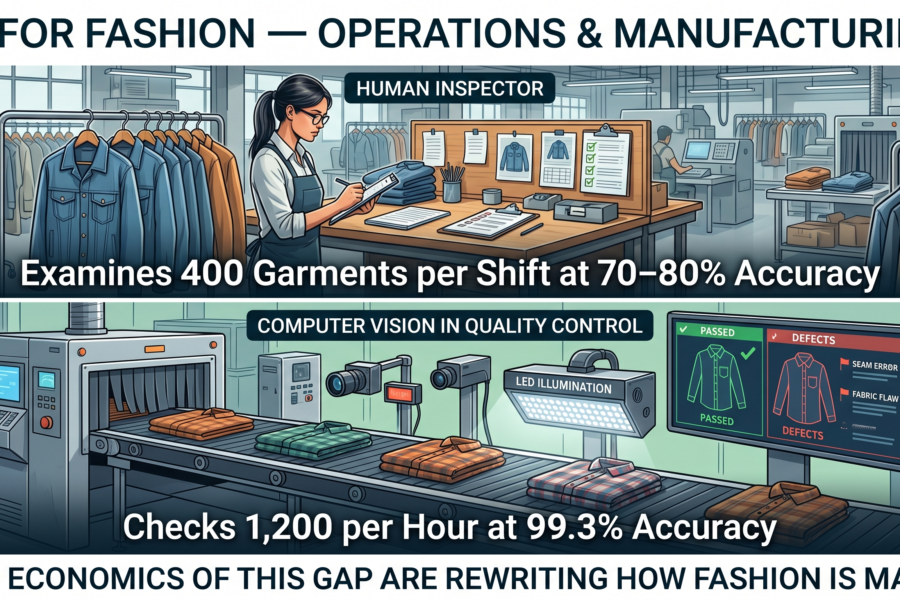
RFID tracks item-level inventory movement. Computer vision adds a second layer: monitoring the physical presentation of stock on the shop floor in real time. Where RFID tells you that 8 units of a particular shirt are in the store, computer vision tells you that only 3 are visible on the rail — the other 5 are in the stockroom — and that the rail has been depleted below the visual merchandising standard that drives optimal sales.
Amazon‘s Go stores use overhead camera arrays with computer vision to track customer interactions with products and infer stock levels in real time — a system so precise it can detect when a customer picks up an item, considers it, and puts it back. While Amazon Go is primarily a grocery format, the underlying technology is being licensed to fashion retailers as shelf intelligence infrastructure. Standard AI (now acquired by Standard Cognition) and Trigo offer similar shelf monitoring platforms for fashion and general retail environments.
Autonomous mobile robots — such as those from Simbe Robotics (Tally) and Brain Corp — patrol store aisles on scheduled routes, using cameras and AI to detect out-of-stock positions, misplaced items, and incorrect price tags. Walmart and BJ’s Wholesale have both deployed Simbe’s Tally robot at scale. In fashion-specific applications, these robots can detect when a fixture has fallen below a minimum face-out threshold and automatically generate a task for a store associate to replenish from the stockroom — replacing the unreliable process of visual floor walks by busy staff.
“An RFID system tells you the shirt is in the store. A computer vision system tells you the shirt is in the stockroom, not on the floor, and that the rail has been under-filled for six hours. Only the second piece of information actually prevents a lost sale.”
Retail operations analysis, 2024
AI Replenishment: When the Algorithm Orders the Stock
Knowing what stock you have is the foundation. The intelligence layer on top is knowing what stock you will need — and ordering it before you run out. AI replenishment systems combine real-time inventory data with demand forecasting models to generate automatic replenishment recommendations (or, in more advanced deployments, automatic replenishment orders without human approval).
As we covered in depth in our demand forecasting article, these models ingest a range of signals beyond historical sales: social trend data, weather forecasts, event calendars, competitor price changes, and promotional schedules. The replenishment algorithm synthesises these signals into a SKU-level, store-level prediction of how many units will be needed over the next replenishment cycle — and calculates the optimal order quantity and timing to maintain target stock cover without tipping into overstock.
Zara’s replenishment system, the most studied in the industry, generates automatic store orders twice a week based on RFID sales data from every store. Store managers do not place orders — the system determines what each store needs based on what it sold, what it has in stock, what is trending in that store’s catchment area, and what production capacity is available. The result is the 72-hour replenishment cycle that defines Zara’s competitive model.
Nike deployed an AI replenishment system called Nike Direct that manages inventory across its DTC stores and wholesale partners, using sell-through data and demand signals to optimise allocation. The system reportedly reduced out-of-stock incidents on key silhouettes by 15% while simultaneously reducing excess inventory positions — the dual benefit that only AI inventory systems can reliably deliver. Lululemon uses AI replenishment to manage its highly complex SKU matrix — thousands of styles in multiple sizes and colours across a global store network — achieving a below-2% out-of-stock rate on core product lines.
What AI Replenishment Ingests
Real-Time Sales
RFID sell-through by SKU, size, colour, store — updated continuously
Weather Forecasts
7–14 day weather outlook per store catchment area
Social Signals
Search trends, social mentions, viral product activity
Event Calendar
Promotions, holidays, local events, competitor activity
Supply Availability
DC stock, in-transit inventory, production lead times
Replenishment Order
Optimal quantity, timing, and routing — generated automatically
Omnichannel Inventory: One Pool, Every Channel
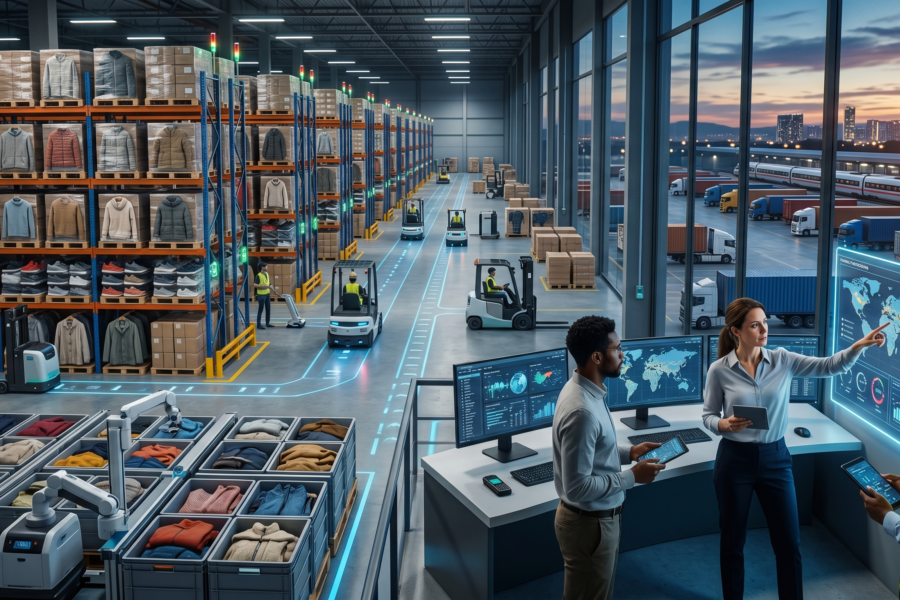
The most commercially significant development in fashion inventory management over the past five years has been the shift from siloed channel inventory to a unified inventory pool — a single view of all stock across all channels (stores, DC, in-transit, third-party logistics) that can be allocated dynamically to wherever demand is highest.
Without unified inventory, a brand might show an item as “out of stock online” when 40 units are sitting in a store 3 miles from the customer’s location — because the store inventory is not available to the online channel. This was the norm for most traditional fashion retailers as recently as 2018. AI-powered order management systems (OMS) from vendors like Manhattan Associates, OneStock, and Fluent Commerce now make unified inventory a commercial reality, allowing brands to promise and fulfil from any inventory location.
Ship from store — fulfilling online orders from store inventory rather than from a central DC — is the most visible expression of unified inventory, and it depends entirely on accurate, real-time store-level inventory data. John Lewis in the UK attributes a significant portion of its online fulfilment improvement to ship-from-store capability enabled by RFID inventory accuracy. ASOS and Zalando both use AI allocation engines that decide, order by order, whether to fulfil from DC or from a nearby store based on speed, cost, and current stock levels.
The AI layer in unified inventory goes beyond simple OMS routing. Inventory allocation AI manages the harder problem: when you have limited stock of a popular item and multiple demand signals — stores needing replenishment, online orders to fill, wholesale orders to complete — which channel gets the stock? AI allocation systems optimise this decision across the full demand picture, accounting for margin by channel, customer lifetime value, contractual commitments, and the relative cost of a stockout in each context. This is a genuinely complex optimisation problem that human planners cannot solve at the speed or granularity required.
The Size Intelligence Problem: Fashion’s Hardest Stockout
Fashion has a specific inventory problem that generic retail AI systems do not fully address: size intelligence. A style being “in stock” is meaningless if only sizes XS and XXL remain when the majority of demand is for M and L. The most commercially damaging stockout in fashion is not the total absence of an item — it is the absence of the sizes customers actually want while other sizes sit on the rail, triggering a markdown on the entire stock even though half of it would have sold at full price.
AI size curve management addresses this by modelling the size distribution of demand for every style in every store, and using this to optimise both the initial size ratio of orders and the replenishment size mix. Rather than applying a standard size curve (e.g. XS:10%, S:20%, M:30%, L:25%, XL:15%) uniformly across all stores, AI systems now model size demand at the store level — recognising that a store in a university town may have a very different size profile than one in a suburban shopping centre serving an older demographic.
Next, the UK retailer, has been particularly advanced in size intelligence, using AI to model size demand at individual store level for over a decade. Their system adjusts the size ratio of replenishment orders by store on a weekly basis, significantly reducing the proportion of “broken size runs” — racks where only extreme sizes remain — that trigger premature markdown. Nike‘s size assortment AI, deployed across its DTC estate, contributed to a reported 12% improvement in full-price sell-through by ensuring size availability aligned with actual demand distribution.
“The most expensive stockout in fashion is not the product that isn’t there. It’s the product that is there — in the wrong size. A broken size run is a markdown waiting to happen.”
AI Inventory Intelligence: Reported Brand Results
| Brand | Technology | Result |
|---|---|---|
| Zara (Inditex) | RFID + automated replenishment, twice-weekly orders | Inventory accuracy 65% → 99%+ |
| Marks & Spencer | RFID across clothing range, AI replenishment | 15% reduction in stockout incidents |
| Nike | Nike Direct AI — DTC + wholesale inventory allocation | 15% OOS reduction; 12% full-price improvement |
| Lululemon | AI replenishment across complex size/colour SKU matrix | <2% OOS rate on core lines |
| Next (UK) | Store-level AI size curve management | Significant reduction in broken size run markdowns |
| Decathlon | Full-range RFID enabling self-checkout + real-time stock | Near-elimination of phantom inventory |
The Digital Twin: A Virtual Mirror of Physical Stock
The most advanced frontier of fashion inventory intelligence is the inventory digital twin — a continuously updated virtual replica of every item across the entire supply chain, from raw material through production, transit, DC, store, and ultimately customer. A true digital twin updates in real time as items move: when a garment is produced, it appears. When it ships, it moves. When it is sold, it disappears. When it is returned, it reappears at its new location.
Digital twin inventory platforms — built by companies like o9 Solutions, Blue Yonder, and Infor — allow fashion brands to run scenario models against their inventory positions in real time. What happens to our stock position if this factory closure delays the next production run by three weeks? Which stores will go out of stock first, and what are the options for covering them from existing network inventory? If we cancel this purchase order to reduce overstock, which future weeks are we exposed on which SKUs?
These are the questions that fashion planning teams spend weeks trying to answer manually. Digital twin AI answers them in minutes — and, increasingly, proactively alerts planners to emerging risks before they ask. PVH Corp deployed an inventory digital twin across its Calvin Klein and Tommy Hilfiger businesses and reported that planners were spending 60% less time on data gathering and scenario building, freeing capacity for the higher-value decisions that still require human judgement.
The Limits: What AI Still Cannot Solve About Stockouts
AI inventory intelligence can eliminate phantom inventory, optimise replenishment timing, redistribute stock intelligently across channels, and manage size curve allocation at the store level. But it cannot fully solve the stockout problem — because stockouts are not exclusively an information or optimisation problem.
True demand spikes are inherently unpredictable. When a product goes viral — a particular trainer worn in a music video, a shade worn by a celebrity at a major event — demand can multiply 10× or 50× in 24 hours. No replenishment AI, however sophisticated, can source production and deliver physical goods faster than physical production and logistics allows. The speed constraint is not information; it is manufacturing lead time.
Supplier and logistics disruption remains a constraint that AI can anticipate but not eliminate. A factory closure, a port congestion event, or a logistics strike can disrupt replenishment regardless of how accurate the demand forecast is. AI systems with supply risk monitoring can shorten response time — but they cannot create inventory that does not exist.
The cost of perfect availability is also a genuine trade-off. Maintaining zero stockouts would require holding safety stock at levels that would tip many brands back into the overstock problem. AI optimises the trade-off between availability and inventory cost — but there is no configuration that delivers both perfect availability and zero excess inventory simultaneously. The algorithm finds the best feasible point on that curve; it does not make the curve disappear.
Closing the Inventory Trilogy
The Three Articles. The One System.
Article 1
Demand Forecasting
The signal. AI predicts what customers will want, when, and in what quantity — before the product is ordered.
Article 2
Dead Stock Reduction
The correction. When the signal was wrong and overstock accumulates, AI recovers margin through optimised markdown and liquidation.
Article 3
Inventory Intelligence
The execution. Real-time RFID, AI replenishment, and unified inventory ensure the right product reaches the right place at the right time.
These are not three separate AI applications — they are three layers of one integrated inventory system. Brands that have connected all three are operating at a different commercial altitude to those running any one in isolation.
Five Actions for Fashion Inventory Leaders
Start with inventory accuracy — not replenishment AI
An AI replenishment system built on 65% inventory accuracy will make wrong decisions with great confidence. RFID deployment to achieve 99%+ accuracy is the prerequisite for every other inventory intelligence investment. The sequence matters: accuracy first, optimisation second.
Build a unified inventory view before channel-specific tools
Separate store and online inventory systems create artificial stockouts. Invest in an OMS that provides a single inventory truth across all channels — this alone typically recovers 3–5% of revenue by making inventory that is “out of stock online” but sitting in stores available to customers.
Model size demand at the store level, not the brand level
A standard brand-level size curve applied uniformly across all stores guarantees size stockouts in some locations and overstock in others. Store-level size intelligence is one of the highest-ROI AI investments available to fashion retailers — it reduces markdowns caused by broken size runs while improving availability of the sizes customers actually want.
Connect inventory intelligence to the demand forecasting layer
The full value of AI inventory management is only realised when the replenishment system is connected to the demand forecasting model — so that anticipated demand spikes (from a promotional campaign, an event, a weather shift) automatically trigger pre-positioned inventory movements before the demand arrives, not after.
Measure the cost of a stockout, not just its frequency
A stockout on a £20 basic and a stockout on a £200 hero product are not equivalent events. AI inventory prioritisation should weight availability protection by item value, margin contribution, and strategic importance. Measuring stockout cost rather than stockout rate drives better investment decisions about where to hold safety stock and where to accept risk.
“Out of stock” is not a statement about product availability. It is a statement about information quality. When a brand’s systems know exactly where every item is, in real time, across every channel, the out-of-stock message becomes an engineering failure — not a commercial inevitability.
Fashion has accepted phantom inventory, broken size runs, and artificial channel stockouts as structural features for too long. RFID, computer vision, and AI replenishment have turned each of these into solved problems — for the brands willing to invest in solving them. The $1 trillion in lost sales is not lost because there is no product. It is lost because the product is in the wrong place. And AI now knows exactly where that place is.
AI for Fashion Series
Read More Articles
An ongoing editorial series exploring artificial intelligence across every dimension of the fashion industry.