AI and Haute Couture —Luxury’s Complicated Relationship with Automation
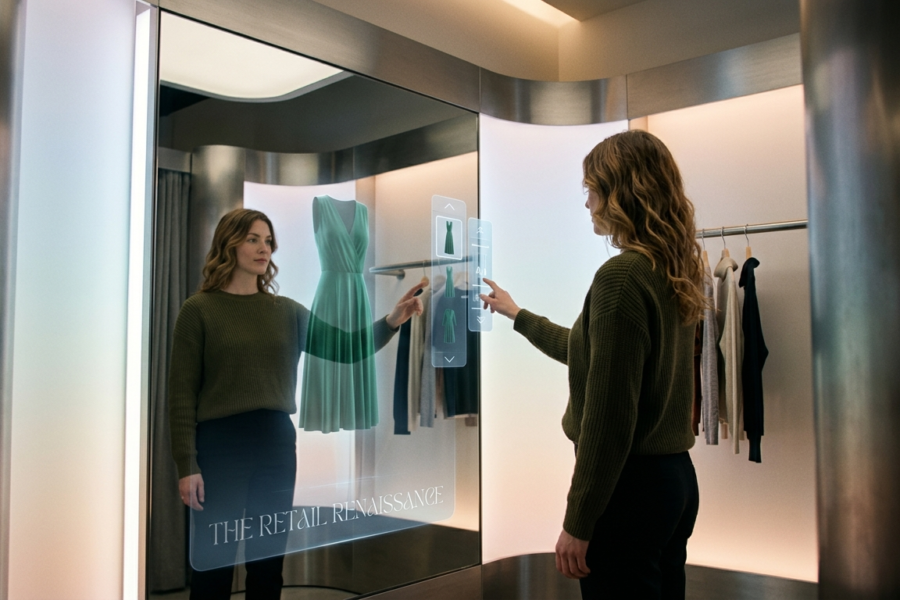
The illuminated wall went dark. A virtual audience appeared, staring back at the very real one in a disconcerting mirror effect. And when the Parisian audience looked left to await the first model, it was from that very screen that she emerged — wearing a dress that didn’t exist yet.
This was Hors-Champs, Alexis Mabille’s Spring/Summer 2026 haute couture collection. Five months of production. Up to 300 tests per look. His petites mains — the legendary seamstresses of haute couture — collaborating with computer specialists to model the real-world behaviour of crepe, organza, silks, dry woollens, and ostrich feathers in digital space.
“The idea was to go against the grain with AI — to show that the human element remains essential behind it. Without our ideas, without the hands of technicians, there’s not much that happens apart from degenerative outcomes.”
— Alexis Mabille, Hors-Champs 2026
The fashion industry has spent decades treating luxury and technology as opposites — one rooted in time, patience, and human mastery; the other in speed, scale, and automation. In 2026, that binary collapsed. Not because technology won. Not because craft surrendered. But because the most visionary designers stopped choosing between them.
What is unfolding in the great ateliers of Paris, Milan, and beyond is not a technology story. It is a story about what happens when three centuries of accumulated human skill encounters the most powerful amplification tool ever invented — and decides, deliberately, how to dance with it rather than be replaced by it.
AI makes the mediocre obvious, but makes the masterful magnificent. The paradox is elegant — and it is the central truth of luxury in 2026.
Precedence Research predicts the AI fashion market will reach $60 billion by 2034, growing at nearly 40% annually. LVMH has formalised its “AI for All” strategy. Gucci’s February 2026 Primavera campaign — generated entirely by AI — ignited a fierce industry debate: does automation dilute luxury’s human soul, or liberate it?
The question feels loaded because it assumes a zero-sum relationship. It doesn’t account for the possibility that automation and craftsmanship might occupy different layers of the same garment — one handling what humans can’t do efficiently, one handling what machines can’t do meaningfully.
- Speed
- Scale
- Efficiency
- Infinite variation
- Reproducibility
- Time
- Scarcity
- Craftsmanship
- Singular vision
- Irreproducibility
These values appear opposed. 2026 is revealing they are complementary when wielded with intention.
“I don’t think it’s controversial. This is 2026. I’m using things as a tool. If I can use it to do something that gives me a quick idea or visualisation, why shouldn’t I? In 2008, retailers were refusing e-commerce because it was ‘not quality.’ I find that ridiculous.”
“There will be a new craft of AI. Algorithms on their own cannot produce good art — you still need a talented creative feeding the prompts, briefing and modelling the AI. That’s why there’s a lot of bad AI art out there: because there’s a lot of bad art in the world in general.”
“The central question is no longer just what the next trend will be, but rather: who — or what — is the author of the aesthetic future?”
In 2026, the most revolutionary luxury houses aren’t choosing between hand and machine. They’re orchestrating both. The most striking example comes not from a technology company, but from one of fashion’s most disciplined houses.
Balenciaga’s Spring 2026 collection made industry history as the first to implement bioengineered silk — developed with Munich-based startup AMSilk through DNA editing and protein engineering inspired by spider silk. The material outperforms conventional silk structurally while transforming its environmental profile.
Balenciaga’s 3D weaving — developed with Weffan — embeds garment construction directly into fabric during weaving on upgraded jacquard looms. The fabric is released from its two-dimensional state via precise incisions and unfolds off-loom into a three-dimensional, origami-like form before traditional hand-finishing.
The result: a classic single-breasted jacket with integrated pockets and sleeves where digital precision and hand-finishing coexist in the same garment. Automation elevating craft to problems humans couldn’t solve alone.
A mood board that once took weeks to curate can now be conjured in seconds. But here’s what the headlines miss: the designers winning in 2026 aren’t using AI to replace inspiration. They’re using it to multiply possibilities faster than any human research process could.
Analyses millions of consumer signals in real-time, helping Chanel, Prada, Dior, and Bottega Veneta translate runway vision into market reality. Trend accuracy exceeds 90%.
Developed with Shin Software and Microsoft, offers 49 billion bespoke garment combinations through social channels including WhatsApp. Personalisation at luxury scale.
Translates the abstract performance needs of elite athletes into physical form through AI. The algorithm as a “digital loom” weaving archival DNA with future-proof engineering.
The designers most likely to embrace AI in 2026 were the ones who already treated technology as a creative language. Demna at Balenciaga, exploring cyber aesthetics and 3D printing since 2015. Alessandro Michele at Valentino, who launched a nine-part digital art series for the Garavani DeVain bag using AI-generated visuals — framed as “an ongoing dialog between human creativity and digital experimentation.”
“Valentino was smart about how they did it — they’re testing the waters with AI. By commissioning external artists through a distinct project, the blame couldn’t come back to them if people reacted negatively. But if people react positively, it becomes something they explore in the future. It’s a sophisticated hedge.”
The most sophisticated luxury strategy in 2026 isn’t “pro-AI” or “anti-AI.” It is “AI-curious, human-confident.”
Here is where the luxury-AI relationship gets most interesting. AI promises speed, efficiency, and scale. Luxury promises time, craftsmanship, and scarcity. These values seem opposed. But luxury isn’t using AI efficiencies to mass-produce — it is using them to reinvest in the irreplaceable.
| Task | Traditional | With AI | Reduction |
|---|---|---|---|
| Full design cycle | 6 months | 2–8 weeks | 75–85% faster |
| Pattern development | 8–12 hours | 10 minutes | ~99% faster |
| Physical samples | Full production sample sets | 60–90% fewer needed | Major cost + carbon saving |
| Cost per design | Baseline | 40–75% lower | McKinsey: $150–275B profit uplift |
The top 10% of earners account for 50% of GDP. They are not pulling back on luxury expenditures. And what they crave isn’t faster fashion — it is more meaningful fashion. The AI handles the invisible infrastructure. The human hand handles the visible soul. Listrak’s 2026 Beauty and Fashion Benchmarks report — analysed from 130 billion emails and SMS messages — identified the critical truth: “As AI automation continues to be a major player, continuing the human touch with customers is paramount.”
The AI handles the invisible infrastructure. The human hand handles the visible soul. The brands that understand this division are not compromising luxury — they are redefining it.
The Luxury-AI Compact — 2026
2026 introduced a new vocabulary to fashion: “AI slop” — the influx of low-quality, generic content produced at scale, indistinguishable in its mediocrity from a thousand similar outputs. Gucci’s AI-generated Primavera campaign images — from a helmet-haired Milanese socialite to a hyper-gloss ’80s couple — read as high-production fashion editorials. Only later did the brand disclose they were AI-generated. The disclosure divided audiences sharply.
Brand consultant Karmen Tsang: “AI makes content creation lazy, and, as the name suggests, artificial. Luxury brands rely on craftsmanship, storytelling, and cultural leadership. Over-reliance on AI risks producing work that is derivative rather than distinctive — instantly forgettable content that adds little real value.”
Charlie Smith (Loewe): “Almost every fashion photographer and their team now uses AI for retouching rather than having a person on Photoshop recolouring a button — it’s faster and more effective. People are doing shoots then completely creating a new environment behind the person using AI.”
The lesson for luxury in 2026: AI is a magnifying glass. It amplifies both excellence and mediocrity. The brands that thrive are those using it to enhance human vision, not replace human judgment. Gucci’s controversy wasn’t about using AI. It was about the delayed disclosure. Transparency, it turns out, is itself a luxury value.
Valentino’s approach — clearly labelling when AI was used in their digital art series — earned respect even from sceptics. Gucci’s delayed disclosure sparked backlash. In 2026, honesty about automation is itself a luxury value. The consumer who discovers AI usage after the fact feels deceived. The consumer who is told upfront feels invited into the process.
LVMH’s “AI for All” strategy focuses on backend operations — supply chain, inventory, customer service — while keeping creative and craft narratives human-facing. The smartest luxury brands automate what customers don’t see, and hand-craft what they do. The algorithm optimises the logistics. The petite main stitches the hem. Both are essential. Only one is the story.
Alexis Mabille’s Hors-Champs didn’t emerge from a prompt. It emerged from 300 tests per look, guided by a designer’s eye, refined by petites mains expertise, and executed through digital tools. The AI was the instrument. Mabille was the composer. Every great luxury deployment of AI in 2026 has this architecture: human vision at the centre, technology at the perimeter. Never the reverse.
Balenciaga’s 3D weaving and bioengineered silk demonstrate that AI-driven precision can reduce waste while elevating craft. The 97% water reduction and 81% lower carbon emissions aren’t compromises — they’re improvements made possible only by technology working in service of intention. Luxury’s future customers will demand this convergence: beauty that doesn’t cost the earth.
The future luxury consumer — Gen Z and Gen Alpha, now accounting for approximately 50% of global beauty and fashion engagement through digital channels — doesn’t see a contradiction between craftsmanship and technology. They see possibility. They won’t ask “Was this made by hand?” They will ask “Was this made with intention?” And intention — judgment, taste, cultural awareness — is the one thing algorithms cannot generate. They can only amplify it.
The petites mains still exist. The needle techniques refined over three centuries still matter. The ostrich feathers, the silk organza, the hand-stitched hems — they’re all still present in the ateliers of 2026. But now they are joined by neural networks that can simulate 300 variations before a single thread is pulled.
This is not the end of haute couture. It is the widening of what couture can become.
Alexis Mabille didn’t ask the Fédération de la Haute Couture et de la Mode for permission. “Of course not!” he said. “I’m delighted that we’ve put our finger on something that will spark other things. Couture isn’t necessarily at the vanguard — but it reinvents itself all the time.”
“It would have been easy to veer into the bizarre and the outlandish. But this is a controlled, streamlined collection that shows you can create through a different, more mechanical approach. Controlled. Streamlined. Human-guided.”
The luxury brands that will define the next decade are not choosing between tradition and innovation. They are deciding how gracefully those two forces dance together. The algorithm can generate infinite variations. But only a human eye can recognise the one that matters. Only a human hand can finish the hem that makes a customer weep. Only a human heart can build the story that makes a garment worth keeping for a lifetime.
That is the luxury proposition in 2026. It was never about what was made. It was always about the intention behind the making. AI cannot generate intention. It can only amplify the one you already have.
The ateliers of 2026 aren’t choosing between the needle and the network.
They’re threading both through the same fabric. The only question is whether your human vision will guide the algorithm — or the other way around.