Virtual Try-Ons and the Riseof Augmented Reality Fitting Rooms
In 1897, the first fitting room appeared in a Paris department store. For 129 years it remained essentially unchanged: a box, a mirror, a hook, and a hope.
In 2026, we didn’t replace it. We evolved it.
The global merchandise returns figure reached $743 billion in 2026. For most retailers, that number registers as a crisis — a liability on the balance sheet, a logistics nightmare, a signal that something is broken. For visionary brands, it registered as something else entirely: a message. The message was simple and devastating: customers cannot tell how things will look on them before they buy.
Augmented reality fitting rooms are the industry’s answer. Not a bigger mirror. Not a smarter size chart. Something that feels like magic until you realise it’s been sitting in your customer’s pocket all along.
This is not a technology story. It is a story about the most fundamental human desire in fashion: the desire to know, before you commit, that something is right for you.
Every returned garment tells a story. It says: I imagined this would look different on me. That gap between imagination and reality is fashion retail’s oldest unsolved problem — and at $743 billion annually, its most expensive one. Processing a single return costs retailers $15–30 in logistics, restocking, and potential markdowns. Across the industry, that compounds into a structural drain that no discount strategy, loyalty programme, or free returns policy has ever fixed.
The reason is architectural. Online fashion was built on the assumption that photographs could substitute for experience. They cannot. A flat image on a screen conveys colour, silhouette, and style. It cannot convey how a bias-cut silk moves when you walk, whether the shoulders of a blazer sit correctly on your frame, or whether the hem of a dress hits at a flattering point on your specific body. The customer buys the image. They return the reality.
- 📦 $743B in annual returns industry-wide
- 💸 $15–30 cost per returned item
- 🔄 “Bracketing” — buying 2 sizes, keeping 1
- 😞 30%+ of online apparel purchases returned
- ✅ 15–60% return rate reduction
- ✅ Up to 34% conversion rate increase
- ✅ 2.4x longer time-on-site per session
- ✅ 71% of consumers actively seek AR brands
The virtual try-on market reached $15.29 billion in 2026, up from $12.09 billion in 2025 — a 26.5% compound annual growth rate that signals something beyond a technology trend. Markets don’t grow at 26.5% CAGR because companies are pushing a product. They grow at that rate because consumers are pulling for an experience. By 2030, projections place the market at $38.92 billion — a near tripling in four years.
Asia-Pacific is leading the charge with a 26.84% CAGR, driven by mobile-first shopping ecosystems where the smartphone is the primary retail interface. WebAR technology — augmented reality that runs directly in mobile browsers, requiring no app download — is removing the last friction barrier between consumer curiosity and immersive product experience. 90% of consumers say they are open to using AR in shopping. Of those who actually experience it, 98% find it genuinely useful. That is not an adoption metric. That is a verdict.
The smartphone camera has become the most welcoming sales associate in history. It is always available, never condescending, and it never tells you the dress doesn’t come in your size.
On the Democratisation of Fashion Discovery
Three architectural principles define how the best AR shopping experiences are built — and why they work when traditional digital merchandising has consistently failed to close the imagination-to-purchase gap.
For decades, online fashion asked customers to imagine themselves as a 6-foot, size-2 model. 2026’s AR fitting rooms don’t rely on generic models — they honour the actual person buying. Generative AI now understands fabric physics: how silk flows versus how denim holds its structure. It maps this onto your actual 2D photo or mirror selfie, generating a digital avatar that moves, turns, and reveals the garment from every angle. GAP pioneered this with their AR Dressing Room App, inviting users to input height, weight, and body shape to generate a personalised avatar. The “bracketing” habit — buying two sizes, keeping one — is fading because customers can finally preview how garments complement their individual body shape before committing.
90% of consumers are open to using AR in shopping. Of those who experience it, 98% find it helpful — statistics that no other retail technology has ever achieved. WebAR removes the last friction barrier: augmented reality now runs directly in mobile browsers, requiring no app download. The 2026 evolution from static images to video try-ons is accelerating — users want to see how a dress flows when they walk, how jeans settle when they sit, how sunglasses catch light when they tilt their head. Social commerce platforms like TikTok and Snapchat are weaving these features natively, transforming every user into a potential brand storyteller.
AR fitting rooms are the most elegant return-prevention technology ever created. By inviting consumers to visualise fit, fabric behaviour, and styling before purchase, retailers are seeing return rate reductions of 21% to 60%. When multiplied across millions of transactions, this isn’t just an improved customer experience — it’s the elimination of a structural cost that has quietly eroded fashion margins for decades. Every return avoided is a logistics chain not activated, carbon not emitted, and margin point recovered.
The technology is no longer experimental. These are live, revenue-generating deployments — each taking a distinct architectural approach to the same fundamental challenge.
GAP’s AR Dressing Room App invites users to input height, weight, and body shape, then generates a personalised digital avatar that moves and rotates to reveal garments from every angle. The system maps fabric physics onto individual body types, making the “buying blind” problem structurally obsolete.
Adidas deployed AR try-on for footwear that overlays shoes onto a live camera feed in real-time. The technology accounts for foot angle, lighting, and scale — allowing customers to see exactly how a trainer looks on their actual foot before purchase. Returns in footwear, notoriously high due to fit issues, fall significantly with try-on deployment.
Snapchat’s AR try-on lenses have turned social discovery into a commerce funnel. Users try on garments within Stories and Discover, share results with their social graph, and purchase without leaving the platform. The social sharing element creates organic brand reach — every try-on is a potential advertisement to the user’s network.
Zara’s in-store AR app deploys models who appear through customers’ smartphone screens to model garments when pointed at specific display areas or window displays. The experience blurs the line between physical and digital retail — products exist in physical space, but the styling information and model context are delivered digitally, reducing the need for large in-store display inventories.
If AR fitting rooms are this transformative, why isn’t every retailer deploying them today? The honest answer is that 60% of retailers are still navigating implementation challenges — particularly around accurate body measurements and 3D garment modelling. The technology rewards preparation. High-quality 3D models require investment. AI-driven size prediction demands data infrastructure. But the landscape is shifting rapidly.
63%
90%
98%
71%
60%
By 2027, industry experts project that virtual try-on functionality will be considered as essential for major apparel brands as payment gateways or shopping carts — particularly for Gen Z-facing labels. The question for executives is not whether this investment is justified. It is whether their brand can afford to grow without it while competitors build the capability first.
A box, a mirror, a hook. The concept of private garment evaluation revolutionised retail. The form remained unchanged for over a century.
Fashion moved online but the fitting room was replaced by a photograph. The mismatch between image and reality created the returns epidemic.
First-generation AR try-on launches from IKEA (furniture), Warby Parker (glasses), and early fashion pilots. Technology works but 3D models are expensive and quality is inconsistent.
AI-driven fabric physics simulation makes 3D garment modelling affordable at scale. WebAR removes app download barrier. Social platforms integrate try-on natively. Mass-market deployment begins.
$15.29B market. 63% of fashion e-commerce platforms integrating AR. Video try-ons replacing static images. Mixed-reality physical stores emerging. The fitting room didn’t disappear — it levelled up.
The most important development in 2026 is not AR try-on as a standalone feature. It is AR try-on as the connective heartbeat of the entire fashion value chain — reaching upstream into design, downstream into fulfilment, and sideways into sustainability.
Platforms like Style3D AI are demonstrating how virtual fitting integrates seamlessly with design, pattern creation, and production workflows. Designers sketch a garment, simulate it on diverse body types, refine patterns in real-time, and flow directly into production — all within a single digital ecosystem. This eliminates physical samples, each of which carries resource, labour, and carbon footprints. Virtual try-ons aren’t just reducing post-purchase returns — they’re preventing overproduction at the source.
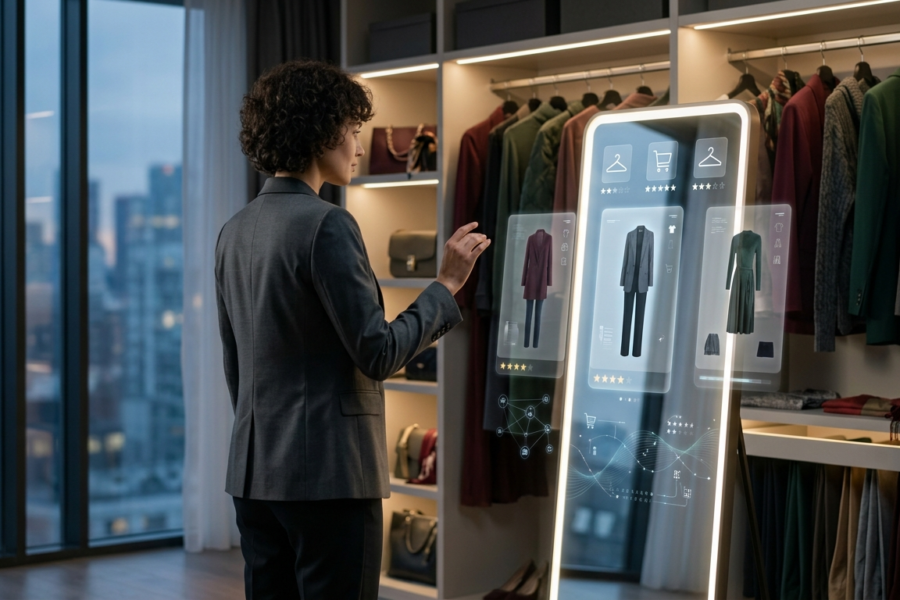
Mixed-reality deployments inside physical stores are forecast to grow at a 27.04% CAGR through 2031. The future store isn’t a warehouse with a cash register. It’s an immersive space where physical inventory meets digital infinite variety — where you try on a dress in-store, but the AR mirror reveals it in 12 different colours, with AI styling recommendations drawn from your purchase history. A personal stylist who never sleeps, embedded in the mirror.
Static image try-on gives way to video — customers see garments in motion. WebAR becomes the default delivery mechanism. App downloads are no longer required for full AR experiences.
AR fitting rooms connect directly to production systems. Customer try-on data informs demand forecasting at the garment level. Physical samples largely eliminated. Overproduction structurally reduced.
Physical stores carry curated inventory; AR mirrors provide infinite digital variety. Try on what’s present, visualise any colour or variation. Mixed-reality CAGR: 27.04% through 2031.
In an industry where a 2% conversion lift sparks celebration, a 34% rise is a structural shift. For mid-size fashion e-commerce, this represents millions in recovered revenue from the same traffic.
Users spend 2.4x longer per session on AR-enabled interfaces. More time browsing means more exposure to inventory — and more opportunities for discovery that wouldn’t have occurred in a standard grid view.
Every return costs $15–30 in logistics alone. A 60% return reduction for a brand processing 1 million returns annually recovers $9–18 million in direct costs — before accounting for restocking, markdowns, and carbon impact.
The infrastructure cost is front-loaded. The competitive advantage is compounding. Brands that delay are not merely missing a feature — they are ceding the customer expectation layer to those who build first. By 2027, virtual try-on will be as expected as a size chart. The question is whether your brand defines the standard, or races to meet it.
AR fitting rooms represent one of the rare moments in fashion’s history where the most profitable decision and the most sustainable decision are the same decision. Fewer returns means fewer logistics journeys, fewer repackaging operations, fewer garments damaged in transit and sent to landfill. Reduced physical sample production means less material, water, and labour consumed before a single unit is sold. Demand signals from virtual try-ons feeding into production planning means manufacturing volumes aligned to actual desire rather than speculative forecasting.
The fashion industry burns through 92 million tonnes of textile waste annually. Virtual try-on doesn’t solve that alone — but it removes one of its root causes. When customers know how something will look on them before purchase, they buy less and keep more. The impulse buy that returns in three days and gets discounted then destroyed is, increasingly, the purchase that never happens because the AR mirror already told the customer the truth.
- 15–60% fewer return logistics journeys
- Physical sample production largely eliminated
- Demand-matched production reduces overstock
- Less deadstock incineration and landfill
The full sustainability value of AR try-on only materialises when connected to the systems explored in this series: demand forecasting (article 3) feeds from try-on engagement data; hyper-personalisation (article 4) combines with fit prediction to approach zero-waste purchasing at individual level.
The fitting room of 2026 is not a room at all. It is a gateway — a bridge between the tactile world we evolved to trust and the digital world we’ve learned to love. It lives in the smartphone in your customer’s pocket. It runs without an app download. It knows their body shape, their style preferences, and their social influence patterns. And it never, ever tells them the dress doesn’t come in their size.
The brands that build this bridge first aren’t just winning sales. They’re redefining what shopping feels like.
The fitting room didn’t disappear. It evolved.
Not with nostalgia, but with neural networks. Not with a bigger mirror, but with the one already in your customer’s pocket.