Hyper-Personalisation: How AI Curates YourWardrobe Before You Ask
The next frontier of fashion isn’t knowing what customers want. It’s knowing what they will want before they do — and the brands that master this are rewriting the economics of the entire industry.
Every fashion executive has received the “You might also like…” email. It’s the digital equivalent of a shop assistant pointing at a nearby rack — reactive, segment-based, and largely interchangeable between brands. Most brands are stuck here. They’ve invested millions in CRM systems and recommendation engines, but they’re still playing catch-up to customer intent rather than anticipating it. Open rates hover around 15–20%. Click-through rates struggle to break 2%. The recommendations feel like they were assembled by someone who read your demographic profile but never met you.
Deep personalisation operates on an entirely different principle. It doesn’t wait for you to express a preference. It builds a predictive model of your taste, your body, your lifestyle, and your next purchase — often before you’ve consciously thought about it yourself.
Surface personalisation is a marketing tactic. Deep personalisation is a business model. The gap between the two is not incremental — it is existential.
| Dimension | Surface Personalisation | Deep Personalisation |
|---|---|---|
| Approach | Reactive — responds to expressed intent | Predictive — anticipates unexpressed need |
| Data Inputs | Purchase history, basic browsing data | Body topology, lifestyle context, social signals, temporal triggers |
| Customer Model | Demographic segment (Urban Pro, 25–34) | Individual predictive profile (taste, fit, lifestyle, timing) |
| Email Open Rate | 15–20% | 35–55% (triggered by predicted need) |
| Conversion Lift | 2–5% | 20–35% |
| Business Role | Marketing feature | Core business model |
| Brand Leaders | Most fashion brands today | Stitch Fix, Amazon, Zalando, ASOS |
Four companies have built fundamentally different deep personalisation architectures. Each solves the same problem — predicting individual taste — through a distinct strategic lens. Understanding the differences reveals what your brand should borrow, and what it should avoid.
Stitch Fix built deep personalisation on explicit data capture that most brands never attempt. New customers complete a comprehensive style quiz covering not just size and colour preferences, but lifestyle context (work from home? formal events?), body shape nuances, price sensitivity, and style evolution goals. This feeds into a hybrid AI-human system — machine learning algorithms generate predictive taste models, but human stylists review and refine selections before delivery.
Their algorithms process over 100 billion data points across style, fit, and preference dimensions. 35% of client feedback directly influences the next Fix selection, creating a continuous learning loop. The result: Stitch Fix charges full price in a market addicted to discounting — because customers aren’t buying clothes, they’re buying curation certainty.
Amazon approaches personalisation through sheer volume of behavioural signals across its entire ecosystem. Every search, hover, cart abandonment, Prime Video watch, Alexa query, and Whole Foods purchase feeds into a unified inference engine. This is cross-domain transfer learning at industrial scale: your interest in hiking documentaries informs outdoor apparel recommendations; your grocery purchases reveal dietary preferences that correlate with lifestyle segments; your Echo’s weather queries predict seasonal wardrobe needs before you search.
The “StyleSnap” feature uses computer vision to photograph any outfit and return shoppable alternatives — but the deeper magic happens when that visual data is cross-referenced with your entire behavioural graph. Amazon doesn’t need to ask your style preferences. It infers them from thousands of micro-signals. The result: 20–35% conversion lifts on personalised vs. generic recommendations — and the occasional “creepy” moment when a winter coat appears the day before an unexpected cold snap.
Zalando, Europe’s largest online fashion retailer, operates under GDPR — the world’s strictest privacy regulatory environment. This constraint forced a more sophisticated architecture built on federated learning and differential privacy. Models train on decentralised data; individual customer profiles are never centrally stored; size-prediction algorithms operate on encrypted data that the company itself cannot fully decode.
Their “Zalando Assistant” uses generative AI for conversational discovery rather than surveillance-based inference — creating explicit value exchange for data sharing. The result validates the privacy-first approach: AI-powered size recommendations reduce return rates by 15–25%. In an industry where return processing can erase the entire profit margin on a garment, this is a transformative sustainability and financial outcome simultaneously.
ASOS has built personalisation around visual search and trend velocity. “Style Match” lets users upload images to find similar items — but the deeper system tracks how visual preferences propagate through its customer base in real-time. When a micro-trend emerges on TikTok, algorithms identify which customer segments are most likely to adopt it and pre-position inventory accordingly.
ASOS integrates social listening data with individual browsing patterns to create “taste velocity scores” — measuring how quickly a customer’s preferences shift in response to cultural signals. This is particularly effective with Gen Z, who exhibit higher taste volatility and stronger social influence effects. Customers engaging with personalised visual discovery features show 2.3x higher lifetime value than those using traditional search.
The clothes are almost incidental to the service of being understood. Deep personalisation doesn’t sell products — it sells certainty.
On Why Stitch Fix Can Charge Full Price
Deep personalisation systems rely on a convergence of data streams that would have been impossible to integrate even five years ago. The key shift is treating every customer interaction not as a transaction to be recorded, but as a signal to be learned from.
Purchase history, return patterns, and exchange behaviour remain the bedrock — but deep personalisation treats these as training signals, not endpoints. A return isn’t a failure; it’s a label that the model’s prediction was incorrect. The reason for the return (fit, colour, style, quality) becomes a feature for the next prediction.
Every hover, scroll depth, time-on-page, and cart abandonment feeds attention models. Zalando and ASOS track not just what you click, but what you almost clicked — items that held your attention but didn’t convert. This “consideration data” is often more predictive of future purchases than actual transactions.
Stitch Fix’s detailed measurements and Zalando’s size-prediction algorithms represent a fundamental shift from sizing (S, M, L) to shape modelling. 3D body scanning via smartphone cameras, now accurate to within centimetres, allows algorithms to predict fit across brands with different cut philosophies. This isn’t personalisation of style — it’s personalisation of physics.
Weather APIs, calendar integration, and seasonal event data allow systems to anticipate need before expression. A customer whose calendar shows a beach holiday in three weeks receives swimwear recommendations before they think to search. A customer in a city entering an unexpected cold snap sees outerwear prioritisation. The system acts on signals the customer hasn’t yet consciously processed.
Instagram saves, Pinterest boards, TikTok engagement, and even Spotify listening patterns provide taste signals that traditional e-commerce data misses entirely. ASOS’s integration of social listening with individual profiles predicts not just individual preference but socially-mediated preference — forecasting what your social graph will make you want before the influence reaches you.
Perhaps the most sophisticated input is the prediction of what you will dislike. Deep personalisation systems model return probability at the individual-item level and suppress recommendations likely to be returned. This isn’t about selling more — it’s about selling right the first time. Every suppressed bad recommendation is a return avoided, a carbon journey not made, and a margin point recovered.
Deep personalisation is not a single technology — it is a layered architecture of specialised models that each solve a different sub-problem of taste prediction. Understanding this stack is essential for any executive planning investment in this space.
Finds customers with similar taste trajectories. “Customers like you who liked X, went on to buy Y.” The foundation of most recommendation engines — mature, reliable, and limited by cold-start problems for new customers and new products.
Extracts garment attributes (neckline, silhouette, print pattern, fabric texture) from product images. Enables visual similarity search and allows the system to understand aesthetic preference without requiring customers to articulate it verbally.
Processes free-text style notes, customer service interactions, and review content to extract preference signals that structured data misses. “I want something that looks smart but isn’t uncomfortable” is richer input than any dropdown menu.
Reinforcement learning technique that balances exploration (showing new items to discover preferences) with exploitation (showing items the model is already confident about). Critical for keeping personalisation from becoming a filter bubble.
Maps individual body topology to brand-specific size charts. Trained on return reason data (“too tight in the shoulders,” “correct size but wrong cut”) to learn how bodies interact with different construction philosophies. The return-reduction engine.
Tracks how micro-trends spread through customer networks in real-time. Predicts which customers are early adopters vs. late majority for each emerging style signal, enabling pre-positioning of inventory before demand registers in sales data.
This connects directly to fashion’s overproduction crisis — 92 million tonnes of textile waste annually, 30% of produced garments never sold — which stems from aggregate demand forecasting. Brands produce for markets, not for people, and the mismatch between population-level predictions and individual reality creates the waste.
Deep personalisation inverts this model. When Stitch Fix can predict with high confidence what a specific customer will purchase and retain, they can purchase inventory at the individual level rather than the demographic level. When Zalando’s size algorithms reduce return rates by 20%, they eliminate the double-transportation carbon cost of the return journey. When ASOS’s trend velocity scores predict which customers will adopt a micro-trend, they produce in quantities matched to actual demand rather than speculative demand.
Forecast for demographic segments. Over-produce to cover uncertainty. Mark down unsold inventory. Incinerate or landfill the rest. Repeat every season. Estimated annual cost: $500 billion in unsold inventory, markdowns, and return processing.
Forecast for individuals. Produce only what predictive models confirm will be purchased and retained. Zero overstock at the individual level aggregates to dramatically lower overstock at the brand level. The same infrastructure drives conversion lifts and sustainability gains simultaneously.
Every executive reading this is simultaneously a consumer being personalised at and a business leader trying to personalise for. That dual perspective creates an uncomfortable recognition: the same technologies that drive business value can feel deeply invasive when experienced from the other side.
The tension centres on data dignity — the customer’s sense of control over what is known about them and how that knowledge is used. Amazon’s cross-domain inference can feel like surveillance because the customer never explicitly consented to their grocery purchases informing their fashion recommendations. When Amazon suggests a winter coat the day before a cold snap hits your city, customers feel simultaneous appreciation and unease. The system knows too much, and it knows it too early.
The regulatory environment is hardening globally. The EU’s GDPR, California’s CCPA, and emerging AI-specific regulations are creating compliance frameworks that favour architectures like Zalando’s privacy-first approach. But regulation is a floor, not a ceiling. The brands that will thrive are those that treat privacy not as a legal constraint but as a competitive differentiator.
Collecting data customers don’t know about for recommendations they don’t find useful. Maximum extraction, minimum trust. Regulatory and reputational exposure.
Customers understand what data is used, receive genuinely useful personalisation in return, and can control their profile. The Stitch Fix quiz and Zalando Assistant model. Highest trust, highest LTV.
Behavioural data used without explicit consent, but within expected boundaries. Works while unnoticed; creates backlash when surfaced. Regulatory exposure increasing.
The critical insight for executives: how much a fashion brand needs to know before personalisation becomes surveillance depends on the value exchange, not the data volume. A customer who receives a perfectly timed, perfectly fitted recommendation may feel understood. The same customer who learns their data was sold to a third party will feel violated. The line is drawn by transparency and control — not by the sophistication of the algorithm.
The investment in deep personalisation infrastructure — data lakes, ML pipelines, computer vision systems, privacy engineering — is substantial. The cost of acquisition in fashion has risen 60% over the past five years. The returns from personalisation are compounding.
| Business Lever | Metric | Source |
|---|---|---|
| Conversion Economics | +20–35% conversion rate on personalised vs. generic | Stitch Fix / Amazon benchmarks |
| Return Reduction | 15–25% fewer returns → $15–25 saved per unit | Zalando / Stitch Fix |
| Lifetime Value Expansion | 2.3x higher LTV for personalised discovery users | ASOS internal data |
| Inventory Efficiency | $10–50M working capital unlocked for mid-size brands | Individual demand forecasting models |
| Personalisation AI Market | $1.1B in 2023 → $5.2B projected by 2030 (CAGR: 25%) | Industry analytics |
| Acquisition Cost Context | +60% rise in acquisition cost over 5 years | Fashion industry benchmark |
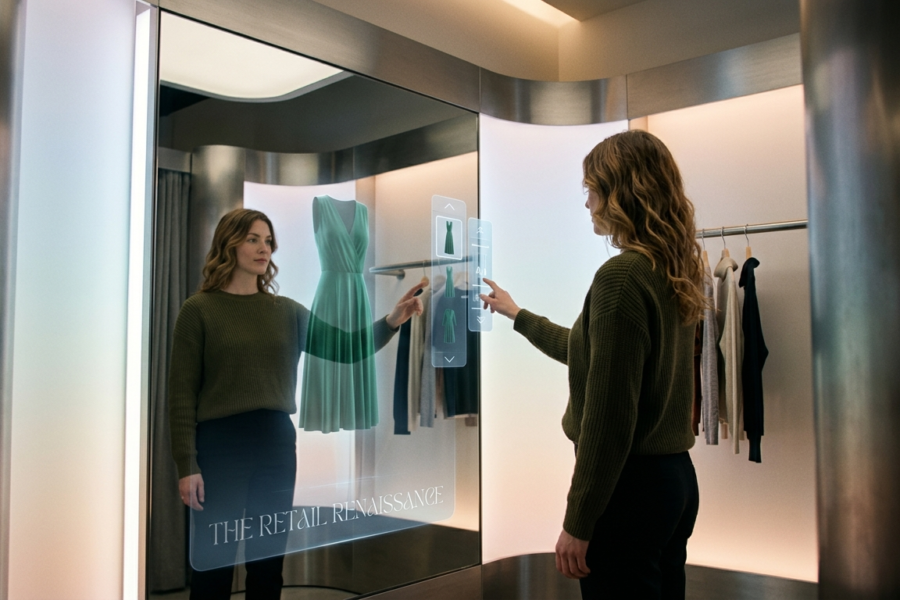
Deep personalisation’s next evolution closes the final gap between prediction and certainty: visualisation. No matter how accurately an AI predicts your taste, a persistent doubt remains — “but will it look right on me?” Augmented reality fitting rooms and virtual try-on technology are building the answer directly into the discovery experience.
Brands like Zara, ASOS, and Nike are deploying AR try-on features that project garments onto a customer’s real-time camera image using computer vision and 3D garment modelling. Early data shows that customers who use virtual try-on features convert at 2–3x higher rates than those who don’t, and return rates drop by up to 40% when customers can visualise fit before purchase. The technology connects personalisation (knowing what you’ll like) with visualisation (seeing it on your body) into a single frictionless experience.
The implications extend further: when a virtual try-on system is combined with a body topology model and a taste prediction engine, the system can say with high confidence — “this garment, in this colour, at this size, will fit your body and suit your taste.” That level of certainty fundamentally changes the economics of fashion retail. The browse-hope-buy-return cycle collapses into a predict-visualise-buy-keep cycle. Overproduction, the returns burden, and the markdown spiral all shrink simultaneously.
The fashion industry is bifurcating. On one side: brands that treat personalisation as a marketing email with a first-name merge field. On the other: brands that have built prediction engines capable of anticipating individual need across taste, fit, lifestyle, and temporal context.
Surface personalisation will be table stakes within three years. Every brand will have a recommendation engine. Investing only in this layer is investing in a commodity. The ROI will continue to compress as the technology commoditises.
Fit is the single biggest driver of returns in fashion. Investing in size and fit prediction models — even before taste prediction — delivers immediate, measurable ROI through return reduction. It also builds the body topology database that makes deeper personalisation possible later.
Privacy-preserving personalisation is not a constraint — it is a moat. Brands that build transparent data practices now will have the trust assets that make customers willing to share the richer data that powers deeper prediction. Zalando’s architecture proves this model works commercially.
The full value of deep personalisation is only realised when customer-level demand signals flow back into production planning. Personalisation that informs marketing but not inventory is capturing 20% of the available value. The remaining 80% is in connecting the prediction layer to the supply chain.
The technology is mature. The data streams are available. The business case is validated by companies that have already built it. The wardrobe of the future won’t be browsed. It will be predicted. The brands that understand this distinction are already building the systems that will define fashion commerce for the next decade. The question is whether your brand will be curating wardrobes before they’re requested — or wondering why your “You might also like…” emails keep landing in the spam folder.
The wardrobe of the future won’t be browsed. It will be predicted.
Surface personalisation is a commodity. Deep personalisation is a moat. The brands building the prediction layer now are defining fashion commerce for the next decade.